Showing posts with label ebook. Show all posts

Monday, 10 December 2012

Glad readers

Although I'm planning to give you a teaser today for the inaugural almost-ready 10K ebook, The Happiest Music on Earth, in the meantime I came across a couple of articles worth sharing.

Writer J.P. Ganley read Road Markings: An Anthropologist in the Antipodes earlier this year:  "I stumbled upon Jackson’s book at Rosa Mira Books – a classy, rather gorgeous looking NZ e-publishing site, by the way – and read the synopsis, blog posts and review. Within seconds I was hitting BUY NOW, and downloaded a copy onto my KOBO e-reader ... I can’t express enough how much I’m enjoying this …" You can read the whole on her blog, A Certain Book.

In the same hour, I was alerted to this appreciative piece about Road Markings by Terence Rissetto in  The Landfall Review Online, NZ books in review.


 Meanwhile (one of my favourite blogwords, I've noticed),  we seem to have a development in the story of 'the other rat'.

Friday, 7 December 2012

Dodging behemoths

Issue 100 of the quarterly review magazine New Zealand Books is out and I was pleased to have been asked to submit an article about the ebook as artifact. I wrote with conviction and enthusiasm for what I'm doing here on Rosa Mira Books and for the opportunities that digital publishing provides. However I admit that the ebook itself as a tiny non-pictorial icon on a desktop, unless and until it is opened and read, is less than appealing. Much depends on the reading device and the attitude of the reader. Even more depends on content.

'Content' is what gives my work hours purpose and pleasure, as I read and discover exceptional writing, help its author to polish it up, and publish it in a digital form that does it credit.

'Content', until it's dealt with in a discriminating manner,  is both wheat and chaff. Today I've come across two or three articles lamenting, for example, 'The Mighty Zon''s bid for world domination of the e/book market. In its haste and greed, Amazon has thrown wheat and chaff (beans and pods might be a more fitting metaphor for the home gardener) in together. And this might be the point at which independent publishers, small and cheeping from their various outposts, begin to regain credibility and value for discerning readers. "Amazon inspires anxiety just about everywhere, but its publishing arm is getting pushback from all sorts of booksellers…" The NY Times article goes on to name stores refusing to sell Kindles, and booksellers refusing to stock Amazon's publications.

In her blog this week, author and editor Anne R. Allen describes the knots that large publishers have recently tied themselvs into, trying to stay afloat and relevant: "HarperCollins, moving to more ebooks, is closing one of its biggest warehouses, and seems set to gobble up Simon and Schuster.  And Simon and Schuster has launched a new scary-scammy self-publishing wing by teaming up with the vanity publisher Author Solutions. Yes, the Author Solutions which was recently acquired by Penguin, which was recently purchased by Random House."

Now, where am I going with this? I'm going towards small, discriminating e/book businesses trying to hold their heads up and put out fine work in the shadow of such behemoths as Amazon and Penguin-Random-Pearson. I came across Seraph Press today, not digital, but putting out a handful of finely produced volumes by NZ poets, most recently The Comforter by Helen Lehndorf. It is possible to buy books online elsewhere than Amazon, even if you run a Kindle. For example, meBooks stocks a wide range of ebooks by New Zealand authors, including Rosa Mira's. But if you want to support a small publisher, see if you can buy directly from their site. That helps them immediately and directly. It cheers them up, too. Please let me know of any small, selective digital publishers out there in the wider world. I'd like to point them out here.

Talking of knots, whose is the tail beside Ratty's? What happened to Lily? And what is the marketing department up to?


Friday, 14 September 2012

Frisky people!

Dorothee's been cooking up a treat.

While writing and researching for The Glass Harmonica, she kept coming across evidence that American forbears weren't the puritanical bunch it's often assumed. She told the Ashland Daily Tidings how she came across some erotic pictures in a history text. "'I was so astonished at how explicit the erotic art of the time was. I started calling rare-book libraries and asking if they had any smutty stuff. And they did.'"


 To make the most of the wealth of infomration, art, poetry and objects that came to light, Dorothee's created a media-enhanced ebook:  Such Were My Temptations: Bawdy Americans 1760-1830. "Loaded with poetry, prose and art, the e-book depicts this country's founding forefathers and foremothers as quite passionate …. It even includes an engraving of Benjamin Franklin and a lady friend having an intimate moment. While graphic in places, the e-book's aim is pleasantly academic rather than pornographic. It's smart, fun and challenges widely held assumptions."

With Such Were My Temptations, Dorothee pushes boundaries in her own right, expanding the definition of the book, adding dimension to the reading experience in ways only recently made possible. Rather than adding content just because it is technically possible to do so, Dorothee finds that sweet spot where content comes alive with new technology. One example is a polyamory poem, dry to read in early English. Such Were My Temptations presents a vivid video of the poem to help readers feel what that old word ‘ribald’ really means.


“Kocks leaves no stone unturned in upsetting today’s definition of 'Puritanical'. From political sex scandals to polyamorous poetry, New England’s first citizens evidently had plenty in common with today’s Americans. Those who think of the 1760s as an era of widespread chastity should brace themselves for surprise before reading Temptations.”  —The Kinsey Institute for Research in Sex, Gender, and Reproduction

To find Such Were My Temptations and more information run to www.DorotheeKocks.com

Wednesday, 1 August 2012

Some prize!

Elena emailed this morning to share her terrific news: she's been awarded the the Eduardo Mallea Municipal Award of Buenos Aires for her novella, Otro lugar (Another place), published by Ediciones de Copista. Ratty has decided to give her his almost entirely uneaten (and generally peculiar-looking) apple as a token of his estimation. This is a prestigious award, a fantastic reward for her beautiful novella. Congratulations, Elena!


You'll have to agree, it's nicely timed, too, as we ready ourselves to release our novel, Amigas, our happy experiment, as Elena so aptly puts it. She wrote (I paraphrase), an experimental work may turn out a little uneven, but it is necessary and good. "We did something important, you know? We made our little piece of sand. I am very happy with our work." And so am I.

Without knowing it at the time, we made a novel that is entirely fitted to the new technology of the ebook (with internal links that can carry the bilingual reader from English to Spanish and back again). ("Sin saberlo nosotras, estábamos escribiendo un libro que sólo podía publicarse como ebook si queríamos que se apreciara el modo experimental en el que lo escribimos.") By the time we'd finished writing it, Rosa Mira Books was up and running; we decided to publish here.

Checking the the ePub file the other day (yes, the eternally-penultimate version is being sent to and fro again today for checking and fixing), I realised we were in danger of contravening copyright by quoting freely from the Beatles song our teenaged characters sing together in the airport in Rome in 1969. So I cut the words right back (you're allowed to quote song titles); the reader will have to add words and music

Meanwhile, here's Joe Cocker singing 'With a Little Help From My Friends' live in Berlin. (Thanks, Elena. I found it on your FB page.)

Monday, 20 February 2012

Isgar and Dasychord

I strode up to the shop today, thinking that the NZ Listener had posted a review of Road Markings . . . Well, it's a big step, that they're planning to review a digital-first book at all. Good on them. However, I had my wires crossed and no review appeared this week. I'll be on tenterhooks on Mondays until it does. Meanwhile, readers have loved the ebook (one wrote yesterday, 'I felt quite bereft when I finished it') and you can read (and hear) more about it, and Michael, in the blog posts preceding this.

And what's become of the Rat? Fatherhood has been a potent distraction, especially since Lily has taken one of the ratadillo twins back to the pampas to show him off to the wider fairy armadillo family, leaving Ratty with the other.

Remember, I asked for names? Congratulations and thanks go to Jayne and Pam who each offered two possibilities, from which Lily has plucked the component parts to make . . .  well, you've read the names in the title. Isgar is in Argentina. Dasychord is alarmingly quick on the uptake and at six weeks of age is thrashing her father at chess. With that strategic little mind sharpening by the day, I hope she might be persuaded to join the Sales Department.


Wednesday, 1 February 2012

It's a Yes for Road Markings

" … this book is certainly the place to begin a re-consideration of one of our most astute, humane, idiosyncratic, neglected and perdurable writers."
 
 So writes Martin Edmond, author of the  recently published Dark Night: Walking with McCahon. This week, on his website Isinglass, he reviewed Road Markings: An Anthropologist in the Antipodes:

"A nation exacts a penance from those who dared to leave her wrote James Joyce, explaining why his only play was called Exiles; the line is much quoted but most people who do so leave off the next bit: payable on their return. Michael Jackson left his native New Zealand while still a young man, in the first instance for Melbourne, where he worked among the homeless and had his first encounters with Aboriginality. Later he did similar work in London and the Congo and later still went to Sierra Leone, beginning there the fieldwork that has distinguished his vocation as an anthropologist. He has been far more diligent in his repayments than JJ ever was, returning again and again and, each time, illuminating forgotten corners of what he calls the diffuse and dimly lit world of New Zealand’s collective imagination.

"In Road Markings, published as a ebook by Rosa Mira Books of Dunedin and subtitled An Anthropologist in the Antipodes, Jackson sets out on a road trip through his natal land that is also an inquiry into the idea of firstness: the place of origin in our consciousness, the meaning of beginnings, the aura of the primary as a way of authenticating both personal experience and historical truth. This might sound daunting as a theme but his exploration of it is not: this is autobiographical writing of the highest order, in which the personal is resolutely explored but never just for its own sake: Jackson’s own history, that of his family and friends, his colleagues, his mentors, his literary heroes, are woven together to make, not so much a tapestry as a finely calibrated, gorgeously textured, many-coloured mahi harakeke." Read the rest here.


Sunday, 11 December 2011

Great Aunty Dillo's jewels

Thanks to a fine handful of recent ebooks purchasers, Lily the Pink has come hurtling home from Argentina. Ratty has been clutching the flowers since dawn. Not all of Lily's inherited jewellery would fit in the lunchbox.


She brought with her a couple of gourds and bombillas, too, so she and Ratty can drink maté together.

Tuesday, 8 November 2011

The rat ascends

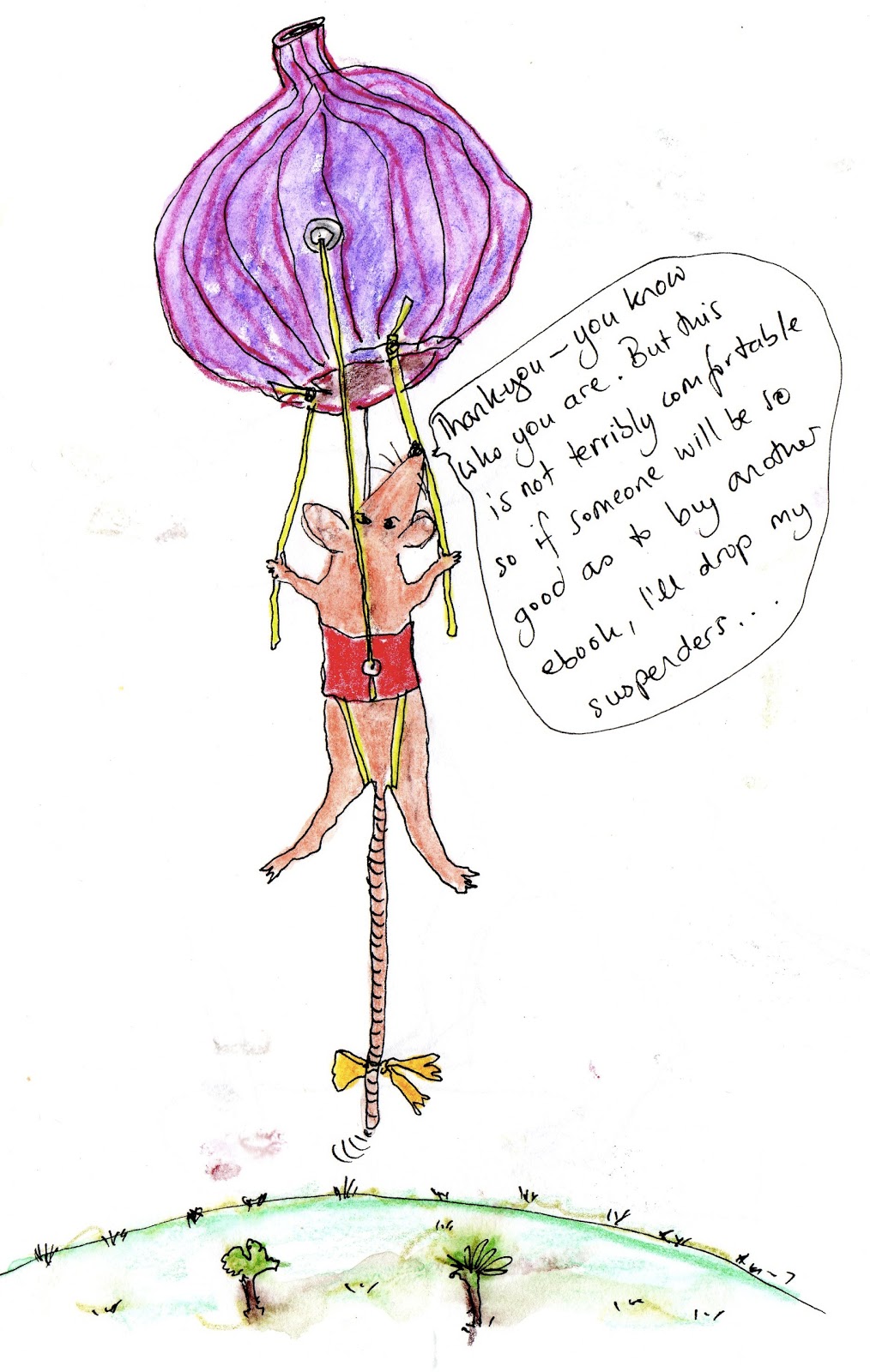
Rat in his birthday suit suspended above Earth by an inflatable onion.

Wednesday, 19 October 2011

He liked it!

…  a provocative novel by an elegant writer who has blazed her own path.

In these days of bite-sized time-bytes into which our days are nibbled, it's a treat to come upon well crafted essay-style blog postings, or book reviews that take time to savour and digest and to analyse the themes of a novel (in this case) within a wider social context. Anyway Dorothee and I were delighted to receive this thoughtful, flavoursome review of The Glass Harmonica: a sensualist's tale by Jim Cullen for the History News Network:
  
"Dorothee Kocks has had an intriguing career. A graduate of the University of Chicago, she went on to pursue a doctorate in American Civilization in the decidedly different climate of Brown (where our paths crossed almost a quarter-century ago). She got a tenure-track job at the University of Utah, proceeding to publish a richly suggestive piece of scholarship, Dream a Little: Land and Social Justice in in Modern America (California, 2000). Then she ditched her teaching post, took up the accordion, and began traveling widely, supporting herself with odd jobs. Last year, she made a foray into fiction by publishing her first novel, The Glass Harmonica, as an e-book with a New Zealand-based publisher. It has just been published in a print edition.

"Kocks's unusual vocational trajectory is worth tracing here, because The Glass Harmonica is an unusual book. A work of historical fiction that bridges the late eighteenth and early nineteenth centuries, it also sprawls across Europe and North America. Napoleon Bonaparte makes a cameo appearance, but its core is a love story between a commoner Corsican musician, Chjara Valle, and an entrepreneurial American purveyor of erotica, Henry Garland. The two lovers encounter any number of obstacles -- principally in the form of spiteful people on either side of the Atlantic -- but nevertheless manage to build a life together,  one animated by the mysteriously alluring (and thus to many threatening) glass harmonica, a musical instrument which enjoyed a vogue in the age of its inventor, Benjamin Franklin.

"Such a summary makes the book seem simpler than it is. For one thing, The Glass Harmonica is rich with historical texture. Brimming with research, it vividly recreates any number of subcultures, ranging from continental drawing-room entertainments to the feverish intensity of revivial meetings. As one might expect of a writer who has spent much of her life, and much of her work, exploring the concept of place, Kocks also evokes varied geographies -- urban Paris and Philadelphia, rural upstate New York, coastal New England;  et. al. An afterword limns her sources and provides set of footnotes worth studying for their own sake.

"Kocks also boldly trespasses over contemporary convention in realistic fiction, eschewing the spare, lean quality of modern prose in favor of lush, omniscient narration. 'On the morning Chjara Valle quickened in her mother's womb, the sun reached its red fingers over the Mediterranean Sea,' the novel opens." See the rest …

Last night I dreamed that a rat ran up my leg – friendly though. This one is holding a placard on the end of his pole, that says, Occupy The Glass Harmonica!

Tuesday, 8 February 2011

What's up?

Wow. I just previewed the film trailer for The Glass Harmonica that Dorothee's cousin Jakob has been making in Berlin, taking in the nape and hands of a beautiful young woman, and a glass harmonica they tracked down in the Musikenstrumentenmuseum in Leipzig. It's going to raise the neck hairs for sure.

So, I'm between two projects at present, but needing to keep active in both. The Glass Harmonica: A Sensualist's Tale is out in the world, being warmly received and quietly gathering readers to itself. We have to keep making its presence known by all the social and web media within our reach and budget. I hope more people will take the leap and buy the ebook, even if they don't have their e-reader yet. More sales means more time I can spend preparing the next manuscript. I believe that all the work I put in to Rosa Mira Books is worthwhile, but at this early stage, each sale gives a boost, that extra 'vote of confidence'. I've applied for funding to help with the next push — getting the Slightly Peculiar Love Stories edited, designed and marketed. This collection is going to be fun to read — quirky, intense, flighty, pensive: there will be a story for every mood.

Meanwhile, I've been reading a manuscript on the iPad's iBooks app. Because the story is well written, spell-checked, and captivating, and although it's in PDF, I might almost be reading an ebook already. Digital readers surely spell death to the slush pile, those toppling boxes of paper, wistful manuscripts that are, in the end, sent home or shredded.

I've yet to download the application Chris told me about: Docs To Go, which enables one to edit Word documents on the iPad. So many devices and applications offer to make our lives more streamlined — if only we overcome the initial resistance against yet another new task, another set of instructions, to learn by measured steps what our children tackle headlong and intuitively.

Friday, 3 December 2010

Author Dorothee Kocks writes:

Writers often daydream about their first publishing contract, and in the States, that dream involves a trip to New York, a ride up some swanky elevator, and a welcome into the community of real writers: no longer an apprentice. 

My moment came in my own foyer. A manila envelope with New Zealand stamps announced that the Rosa Mira Books contract had come and I tore it open, expecting a sheaf of papers to sign, date, return. I had places to go and did not expect to pause but then the papers were sheathed in a pale green sleeve, the color of spring. And inside, a fine ribbon wrapped the document and I could feel publisher Penelope Todd reaching across the miles to say: here you are.


Now I am being contacted by newspaper editors who’ve received a review copy, not via email but by post: in a box with Christine Buess’s lovely cover design and inside, petals from Pen’s garden. A slip of paper gives the online address to receive the book.

What astonishes me most about the ebook revolution is how deeply personal it is. One expects machine worlds to be cold and distant and yet the opposite has been true as The Glass Harmonica has journeyed toward publication. Of course part of this is due to Pen’s personality but that is my point: we are fully here, on the e-frontier. We meet each other not face to face but somehow intimately. Publishing for the last 100 years or so required layers of bureaucracy: from the writer through agents to editors and publishers, then marketing departments and production houses and distribution centers and pulp paper mills. Now small gardens are springing up.

As the first Rosa Mira author, I find myself linked hand to hand with a public relations campaign that is refreshingly not about bamboozling but about finding neighbors in the book world, people who like the same kinds of places. The whole process feels local even as it is so effortlessly global. Here in Utah, I just returned from a walk with my dog and we navigated icy sidewalks and watched a father help his daughter on her bike negotiate a crust of snow. In Dunedin, Pen switches on her camera during our phone call over Skype and the flood of summer bird song enters my study. Meanwhile, in Berlin, Germany, a book trailer seems in the offing as the music museum there houses one of the last surviving 18th century glass harmonicas.

The next step is for the intimate experience of reading to become electronic. I loathed the idea once. I love my paperbacks. I read in the bathtub. But now I have a reading device. I turn the page, and I am carried away. In the end, words are the technology and the magic together, and all else is just details. I hope to meet you here, on the even electronic plain. I'm at dorothee@dorotheekocks.com.

(Photo by James Rendek)


Wednesday, 1 December 2010

Changing dynamics

I started the day anxious. The old method of book launching seems less relevant all the time, but at least it was visible. Books on shelves. An ebook is not like a hard copy whose shelf life is immediately endangered without a great splash in the first crucial days or weeks. I went to Dan Blank for reassurance. And found it on the first page: 'How I learned to stop worrying and love the web'. Okay I'll never love the web like I love my garden or my bed, but I love the generous people I meet there, and I'm learning to trust the subversive new marketing ploy: sustainable chit-chat, leading to sustainable conversation, leading to the linking of like minds, the finding and sharing of books we love, and so on.

Today's list is too long to write here but it includes contact formatter: I sent off a Pages version of the finalised copy of The Glass Harmonica to Jason of meBooks. It was time to get professional formatting — Kindle conversion in particular was proving tricky and he's prompt, friendly and offers a seven-day turnaround.

Leaf. I have it now, set in a square and ready to apply to the RMB facebook Page. Check it out ... tomorrow, I reckon. That leads to further list items: link FB page to blog, Twitter etc.

Check out the good cents site where Tom is blog editor . . . thanks to The Distiller, we plan to exchange energies; he wants some copy advice (and I'll take any advice I'm offered) although what I see looks tight and enticing already.

There are 30 more items on the list. I've crossed off half. One of them is Yoga. I'll go and do a few stretches before dinner.

Wednesday, 1 September 2010

Heartening

I was heartened by this article in Digital Book World, of particular interest to authors and digital publishers, discussing the new and flexible contract, and the 'revolutionary' idea that, in exchange for the author signing over a 'broad basket of rights', each contract would be renegotiated after three to five years. More power to authors. More fair sharing between author and publisher. I'm offering a two-year contract. Makes perfect sense when the market, platforms, and what's implied in those rights are so rapidly changing. We can see up to the next corner but not around it.

While I don't wish to promote one reading device over another (not until I found that perfect, palpable, bendy number), I can't help marvelling at this neat little beast, the Kindle 3, not yet in NZ, but it can be ordered via Amazon. That'd slip into a handbag no trouble. Okay, so I've just promoted a reading device. Which only makes sense, given what I'm doing here. Who wants to read an ebook on their PC?

 I'm not sure I'd want to see a plastic tablet in any of these reverent hands (not unless it wore a soft, indigo cover) but for a beautiful meditation on reading, please look at the images on Steve McCurry's blog.

Monday, 26 July 2010

The mother called Necessity

On Sunday I attended a film workshop. I was struck by the apparent insecurity of the players in this 'industry'. The number of über-bosses whose approval must be gained for a given idea. The number of tricks to be employed in making a pitch. The variety of pitches to be tried, depending on the opportunity given (toe in the door; two floors in an elevator; the full five minutes). The warning that most of these guys (gals weren't mentioned) have ADHD so speak slowly (counter-intuitive, that one). I went away (with a few ideas but) wondering why everyone doesn't just stay home and make their own movies for Youtube instead.

I also talked with a fellow writer: months were ticking by and she hadn't heard back from the publishers who had her manuscripts. The publishers' lists were shrinking. What was she going to do if no one would take her work any more?

That recalled for me my own surprise last year, when Longacre was sold to Random who no longer required its Dunedin editors (or designer, office or production staff). What do we do when our work's not wanted by the big, market-driven publishing houses?

I said to my fellow writer that we could start doing things for ourselves — that this might be the message of the times. It's uncomfortable to contemplate. Starting from scratch at home. Rustling up our own resources. Figuring out a whole new lifestyle. And finding a way to put work out there.

But actually, the ways have been found and forged and they're open to anyone with an internet connection. They needn't imply a decline in quality. In the case of ebooks, we still have manuscript assessors, editors, proof readers, designers. This is democracy for writers — a multiple choice of outlets, a much greater share of the profits, a global market there for the visiting.

It's stretching and scary but it's also fun, cooperative, and more than a little energising. Not only in the writing but in production, too, we dance to our own tune.